Measure and review
Place calibrated reference and standardize lighting → measure dimensions → verify contour → compare comparable images → clinician documents status.
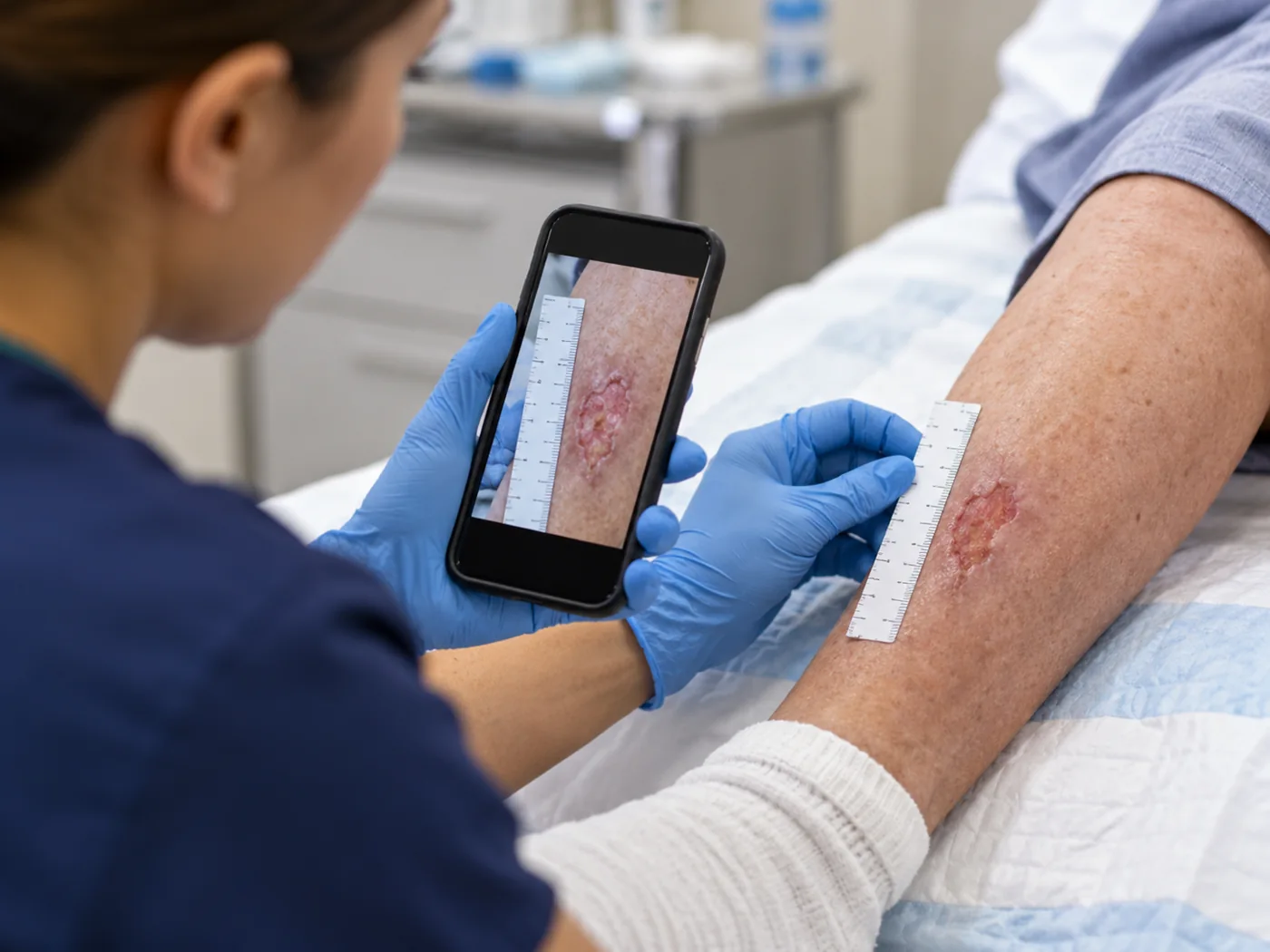
Wound-care measurement can use image segmentation and a scale reference rather than body pose. The same MedMeters reporting layer could capture size changes over time while leaving tissue assessment to trained clinicians.
Product concept and validation roadmap. No MedMeters measurements are clinically available yet.
Wound clinics · Home nursing · Postoperative care. The exact protocol, test equipment and camera requirements matter more than a generic AI movement score.
These are established tests or clinical measurement methods, not a claim that all are currently fully automatable from a single RGB camera.
| Assessment | Source / framework | Potential measurement | Suitable context |
|---|---|---|---|
| Wound length / width | Wound measurement practice | Centimeters with scale reference | Clinic / trained home care |
| Wound surface area | Calibrated image segmentation | Area in cm² | Scale reference required |
| Pressure injury documentation | NPIAP clinical practice | Visible dimensions and photo history | Clinician-led |
| Postoperative incision size | Postoperative observation | Visible length and local changes | Care protocol-dependent |
| PUSH Tool dimensions | PUSH Tool 3.0 component* | Length × width component only | Clinician computes full tool |
Protocol note: *The PUSH Tool includes exudate and tissue type; dimensions alone are not a full PUSH score. Rights and permitted reuse must be checked.
Place calibrated reference and standardize lighting → measure dimensions → verify contour → compare comparable images → clinician documents status.
Lighting, color, perspective and scale calibration materially affect precision. Photo alone cannot determine infection or pressure injury stage.
The software must reject poor-quality captures. Repeated tests should be compared only when protocol version, equipment, assistance and camera conditions are compatible.
Clinic app, selected guided-home follow-up or a healthcare-platform API — all designed around clinician-confirmed measurements and explicit quality metadata.