Measure and review
Screen mobility and fall concerns → select an appropriate standard assessment → review result and determine next clinical action.
CDC STEADI provides published, clinician-friendly mobility and fall-risk assessments. Camera-assisted timing could make repeated measurements easier to document during preventive or geriatric care.
Product concept and validation roadmap. No MedMeters measurements are clinically available yet.
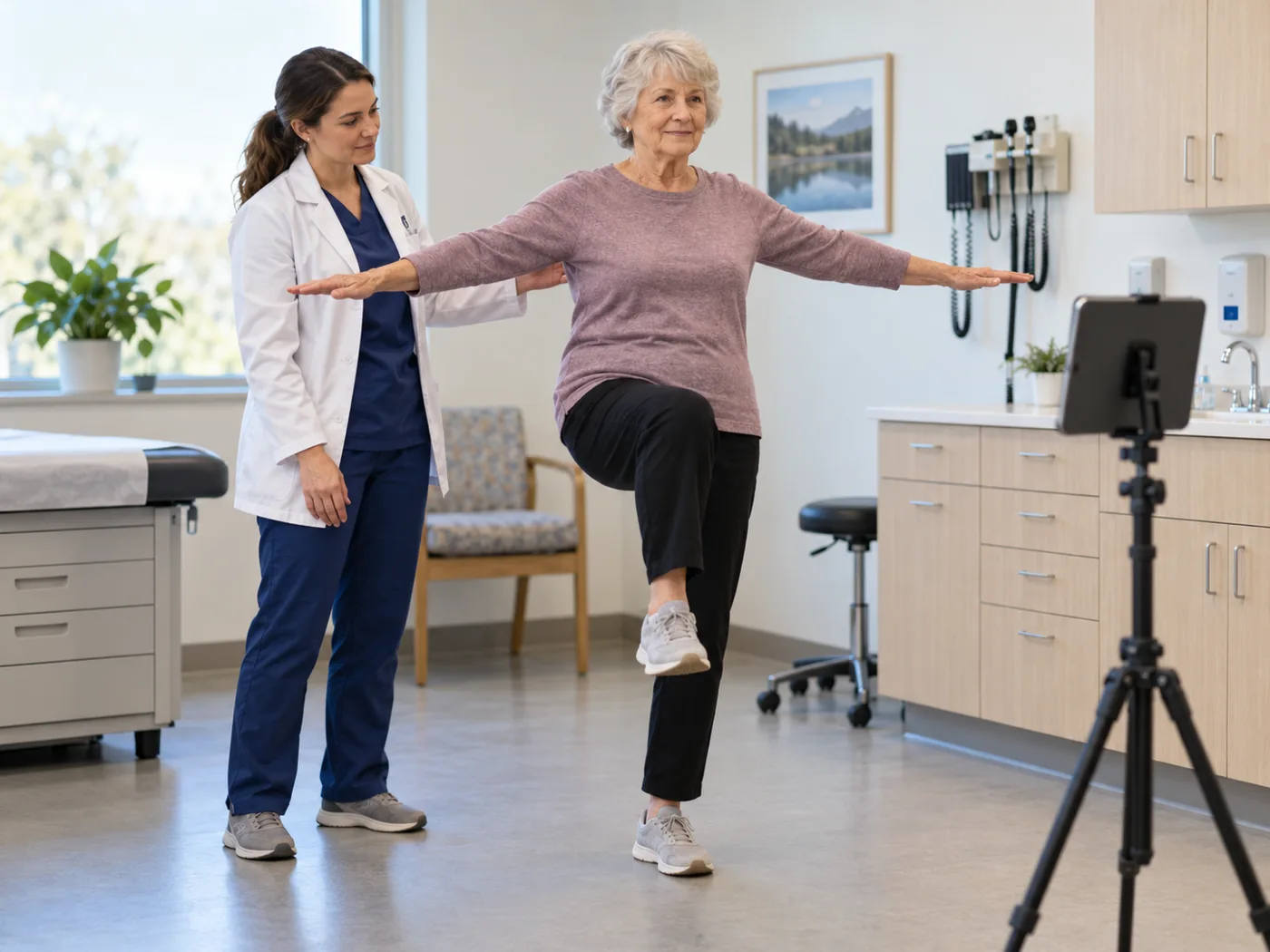
Fall prevention · Senior care · Preventive visits. The exact protocol, test equipment and camera requirements matter more than a generic AI movement score.
These are established tests or clinical measurement methods, not a claim that all are currently fully automatable from a single RGB camera.
| Assessment | Source / framework | Potential measurement | Suitable context |
|---|---|---|---|
| 30-Second Chair Stand | CDC STEADI | Full-stand count in 30 seconds | Clinic first |
| Timed Up and Go | CDC STEADI | Elapsed time over 3 m and return | Supervised |
| 4-Stage Balance Test | CDC STEADI | Time in sequential stances | Physically supervised |
| Short Physical Performance Battery | NIA / SPPB | Balance + 4 m gait + 5xSTS (0–12 after review) | Clinic; clinician-scored |
| 4-Meter Gait Speed | SPPB component | Elapsed time and speed over marked course | Clinic / guided |
Screen mobility and fall concerns → select an appropriate standard assessment → review result and determine next clinical action.
CDC telehealth adaptation requires a safe environment, an appropriate helper and the ability to stop a test. Self-testing is not universally suitable.
The software must reject poor-quality captures. Repeated tests should be compared only when protocol version, equipment, assistance and camera conditions are compatible.
Clinic app, selected guided-home follow-up or a healthcare-platform API — all designed around clinician-confirmed measurements and explicit quality metadata.